
• Mission & Goals
    • Office Tour
    • Investment
    • Locations
    • Privacy & Other Policies
  • Our Team
    • Adult Therapy
    • Therapy for Teens
    • Play Therapy for Kids
    • Family Therapy
    • Couples Counseling
    • Group Therapy
    • Online Therapy
    • Creative Connections - Pre-Teen Girls
    • Hope Quest- Dungeons + Dragons Group- Teens and Preteens
    • Women's Healing Circle
    • Social Skills Group for Kids
    • Grief Workshop
    • Anger Management for Men
    • Parenting Support Workshop
    • Mindfulness Workshop
  • School Based Therapy
  • Reach out today!
Menu

Davidson Family Therapy

709 Northeast Drive, Suite 22
Davidson, NC, 28036
(704)912-4095

Your Custom Text Here

Davidson Family Therapy

  • Welcome
    • Mission & Goals
    • Office Tour
    • Investment
    • Locations
    • Privacy & Other Policies
  • Our Team
  • Services
    • Adult Therapy
    • Therapy for Teens
    • Play Therapy for Kids
    • Family Therapy
    • Couples Counseling
    • Group Therapy
    • Online Therapy
  • Groups Available
    • Creative Connections - Pre-Teen Girls
    • Hope Quest- Dungeons + Dragons Group- Teens and Preteens
    • Women's Healing Circle
    • Social Skills Group for Kids
    • Grief Workshop
    • Anger Management for Men
    • Parenting Support Workshop
    • Mindfulness Workshop
  • School Based Therapy
  • Reach out today!

Kids Worry More When Kept in the Dark

March 18, 2020 Davidson Family Therapy, PLLC
STAY POSITIVE Stay focused STAY Strong.png

The reality of the coronavirus is impossible to avoid. It is hard to go a few minutes without hearing the word or turn on the technology without seeing updates. While we, adults, might be overwhelmed by all of the talk about COVID19, children are equally, if not more, overwhelmed by the lack of talk about the virus. Just like with any major, alarming event, parents may feel daunted by the task of shedding light of this issue to their children. When left in the dark, kid’s fantasies are required to fill void of unspoken chaos around them, and the alarming thing is, their fantasies are often more terrifying than reality itself. That’s right, their imagination of COVID19 is likely scarier than the facts. In fact, I was speaking with a child and asked him what it would be like at home if a family member caught the virus. “Like a real life horror movie,” he said.

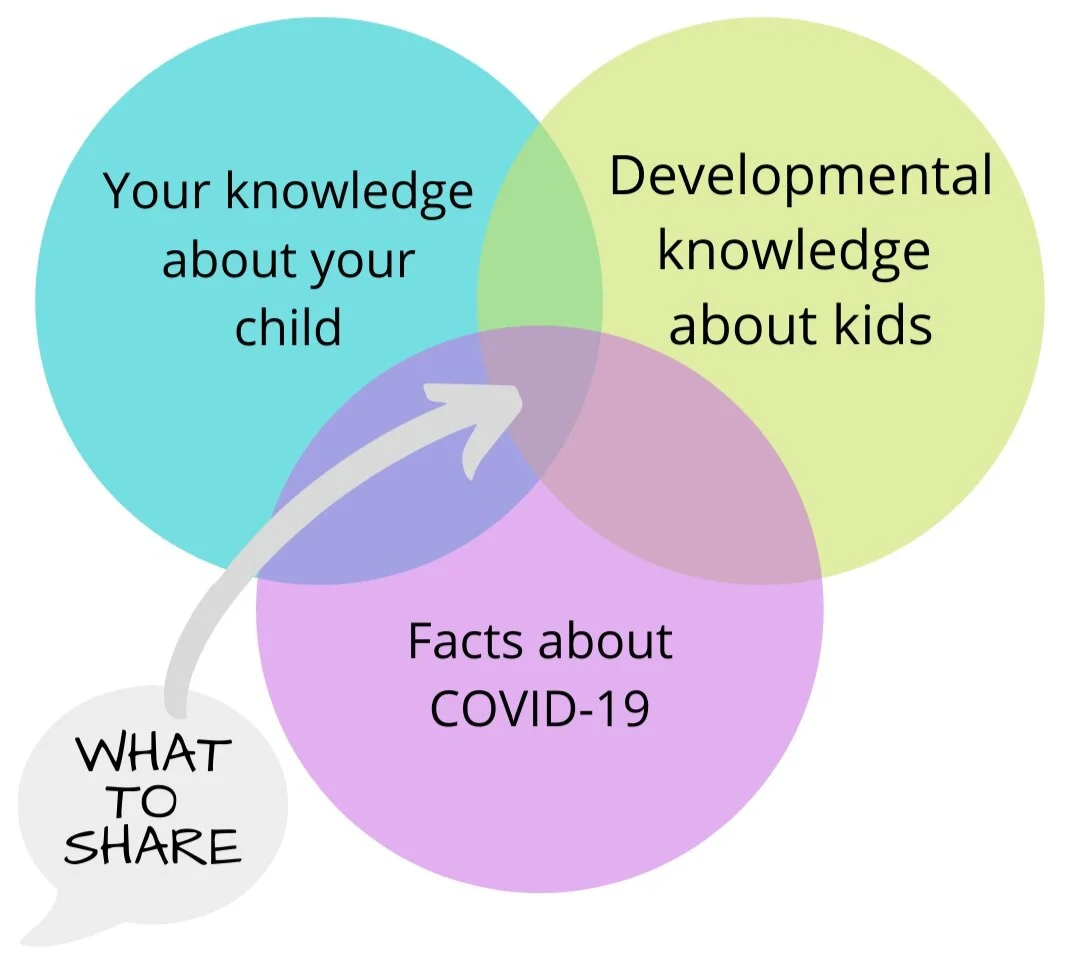
It is our responsibility as adults and parents to explain COVID19 thoroughly to children. Often, our worries of sharing too much cause us to share far too little, leaving many blanks to be filled in by young minds with boundless creativity. So, what is this fine line between over and under-sharing that we call “developmentally appropriate?” Consider this diagram below:
Your+knowledge+about+your+child.jpg


Let’s briefly look at each component to help you understand how to approach you children about the Coronavirus.

Do not underestimate your expertise on your children. You read that right- you are the ultimate expert of your children, and no one knows them better than you. You know their temperaments, how they handle scary parts of movies, and how long they carry their anxieties. Let this knowledge be your compass for how to share the facts of COVID-19.

So what do the experts of child development say about kids? That they can handle the facts when given a safe environment to process their feelings. Children will have big questions about the virus and even bigger feelings related to its real-life implications. It is important to provide a safe space for their feelings to be heard, reflected, and processed. Instead of swooping in and trying to “fix” their feelings and make them feel better, validate their feelings and help them to know they are not alone in feeling them. Take a minute to dwell in their feelings so they can elaborate their fears and explore their worries. Instead of saying “don’t worry” try and say “I understand just how scared you are. Everything is different right now and that is overwhelming, indeed.” Once they feel heard, they may be able to listen to some of the not-so-scary facts.

What facts should children be aware of?

  1. Healthy bodies experience the virus similarly to the flu or a tough cold.

  2. If we catch it, we will likely recover within two weeks and will feel better again.

  3. People do not know they have the virus for a few days or even up to two weeks, which is why it is spreading faster than other colds and viruses.

  4. We are staying inside because we don’t want to spread the virus, not because we are scared of getting the virus.

  5. Even though kids and healthy bodies recover easily, people who are older than 80 or are battling an illness have a harder time fighting the virus.

  6. It takes a community to fight the spread of COVID-19 and staying home and inside helps make sure everyone stays safe and gets better.

Telling children the above information will give them the facts to fill in some of the gaps that may have been festering in their minds these past few days. Help them to know staying at home is temporary. Validate that it is hard. Allow them to feel bored. Empathize when they feel scared. Encourage them through their challenges. Motivate them when it is hard. Praise their selfless efforts. Allow them to feel and struggle just like you.

If you find that your child is still showing signs of being overwhelmed after sharing the facts and empathizing with their feelings, reach out today to chat with one of our child therapists about other possibilities that may help them through this time.

How to Encourage a Thankful Holiday Mindset in your Kids

December 20, 2019 Davidson Family Therapy, PLLC

In the wake of Black Friday, I have been thinking a lot about gratitude. Our culture pays a lot of lip service to being thankful for what we have. We celebrated a national holiday based on the concept! And yet, right after Thanksgiving, we are catapulted into the most materialistic season of the year. In this post, I’ll be talking about how to navigate the holiday season with children, using play therapy skills to teach children gratitude through play.

The day after Thanksgiving, Black Friday sales immediately start peddling the hottest new products to both adults and children. In fact, lots of kids’ culture is based on needing the hottest new toy, from unboxing videos on YouTube to TV commercials targeted directly at children to videogames that constantly push in-game purchases. In a world where Thanksgiving and Christmas are so loaded with messages about needing more, how can we help teach children gratitude and help them to be thankful for what they already have?

Lots of the skills that are “bread and butter” for play therapists can be used by parents at home to promote gratitude in a fun, engaging way. Here are 2 play and activity-based tips to consider if you’d like to encourage your children to develop a more thankful mindset.

Tip #1: Give Your Child Responsibility

In play therapy, we talk a lot about “returning responsibility” to a child, which simply means encouraging children to do things by themselves whenever possible. Rather than jumping in immediately to help if a child is working hard to open a jar lid or balance a tower of blocks, a play therapist allows the child to struggle a bit and try to achieve the task alone. With a little patience, the child can usually do the task all by herself, and feels proud of herself for doing it.

Being responsible for an activity can also help children be more grateful for the end result, because they appreciate the effort that went into it. When children are given a job to do during family chores, cooking, and cleaning, they feel more thankful and take less for granted. Try getting your child involved in preparing his own meals, and encourage your child to work at assembling their new lego set on her own before asking you for help.

Tip #2: Less is More

Play therapists work with toys for a living, and yet if you peek into a play therapist’s office, you’ll likely find a small collection of traditional and fairly “basic” items. Having a mountain of toys in the office can overwhelm children, making them feel more anxious and unfocused, so many play therapists take a “less is more” approach and carefully curate their playrooms to include classic toys rather than the latest “it” item of the season.

Studies show that kids with fewer toys focus for longer and play more creatively than children with more. A study published in Infant and Child Development showed that toddlers in a room with only 4 toys showed more imaginative and advanced play than children in a room with 16 toys. The kids in the 4-toy room were also able to play with their toys for longer periods of time, without becoming distracted.

Children don’t need every hot new toy advertised on TV, or 100 presents under the Christmas tree. In fact, teaching kids how to make do with less might lead to happier, more grateful kids.

Tip #3: Focus on the Memories

A recent “meme” went viral this past week challenging the readers to recall their favorite toys they received for Christmas when they were between the ages of 4-12. The challenge continued by urging the reader to recall their favorite traditions and memories from the same time frame. The challenge was made with the confidence that we all remember the traditions and memories far better than the individual toys and items we’ve received for the past holidays. This isn’t a surprise as many parents witness their children discard their “must have” holiday toys in the abyss of the forgotten toys in the toybox once springtime hits. Engage your children in activities sprinkled throughout the holiday season to keep their spirits high and focused on what truly counts- time spent with family and friends.

The holiday season is intended to be a fun and joyous time, but the pressure from a materialistic society attempts to seep in at every angle, shifting focus on deals and novelties. Try not to be fooled this season by thinking a certain item will make your loved ones happy, and rest assured knowing that research reveals that your presence and connection with your family and friends is what truly influences a joyful holiday.

How to Help your Child with Back-To-School Jitters

November 5, 2019 Davidson Family Therapy, PLLC
Back to School Jitters.png

School has been back in session now for a couple months. Maybe it already seems like ages ago that you snapped that cute photo of your child holding a sign announcing their new grade and teacher’s name. By this point in the year, many children are already fully immersed in standardized testing practice, project deadlines, extracurriculars, and other school activities that can be both exciting and stressful.

I find that this time of year, when the novelty of returning to school has worn off and a routine has set in, is often when I notice many children begin struggling with school anxiety. While it’s normal for most children to feel hesitant to get on the school bus occasionally, or to have a tough time waking up in the morning, some children’s worries about school become so overwhelming that it interferes with their attendance in class. If you’re wondering whether your child’s anxiety about school has reached a level where therapy might be helpful, here are a few questions to consider:

·       How often is the anxiety happening? For example, is it just on Monday mornings following a weekend away, or is it becoming an everyday occurrence?

·       Is your child complaining of physical symptoms, like headaches, stomach aches, or vomiting, that only seem to occur on school days?

·       Is your child’s anxiety response getting stronger or weaker as the school year progresses?

·       Have your child’s worries escalated to the point that tantrums or intense fearfulness are keeping him from being able to attend class?

If you found yourself answering “yes” to a couple of these questions, you are not alone! School is an extremely important, formative part of a child’s life, but the day-to-day experience of attending school can be stressful even for bright, resilient children. The increased focus on standardized testing and the added peer pressure of social media don’t make the experience any easier.  Here are a few tips to help support your child who is struggling with school-related anxiety:

Teach Relaxation Skills

Simple techniques that use the breath or senses to soothe anxiety can be used almost anywhere, and are easy enough that even young children can master them. Teaching your child to take slow, deep belly breaths (called diaphragmatic breathing) can be helpful, as well as helping your child to practice tensing and relaxing the muscles of the body, starting at the head and moving down toward the feet (called progressive muscle relaxation). It’s best to practice these skills repeatedly while the child is feeling calm. That way, the next time she is feeling anxious or panicked, she knows just what to do.

Try Bibliotherapy

Bibliotherapy—using a book as a way to introduce a topic and facilitate conversation about it—can make it easier to broach the subject of school anxiety with a child. Children may feel less nervous or threatened talking about their school worries when the conversation is focused on a fictional character, rather than themselves. A good story can add some much-needed humor to a scary situation, while also helping children feel less alone with their fears. School’s First Day of School by Adam Rex and The Pigeon HAS to go to School by Mo Willems are two of my favorites for approaching the topic of school anxiety with children.

Keep Attendance Consistent

This is the hardest advice to follow, but it might be the most important! When a child is in extreme distress about attending school, it is very tempting to diffuse the situation by allowing them to stay home and relax. Taking an occasional mental health day is not likely to cause problems for most children, but for kids with severe school anxiety it almost always makes their anxiety worse over time. By avoiding the anxiety-provoking situation, we are alleviating a child’s fears for the moment, but also sending a message to the child’s anxiety that school is worth being afraid of. The next day, the child may find it is even more difficult to get to class. Helping children face their fears is the best way to combat anxiety.


For more information and support on how to help your child overcome their worries about school, please reach out to our team at Davidson Family Therapy to hear about how our counselors may be able to help!

-Katie Lear, LPC

Neurofeedback- ADHD Treatment for Kids

May 28, 2019 Davidson Family Therapy, PLLC
Neuro feedback.png

What is Neruofeedback?

Neurofeedback is a form of brain training that uses electrical brain recordings to prompt the process of brain regulation. The feedback used to train the brain is directly impacted by the real-time brainwaves produced by the client. Essentially, the client's brain functioning controls a program in a way that informs them of their brain activity.

Understanding Brain Activity

The brain communicates through electrical signals, called brain waves. Brain activity can be measured through these wave patterns. The slower the waves, the more relaxed the brain & the higher the waves the more alert the brain. Below is a list of the different electromagnetic brainwaves:

22a690_288c41b146e54c6499a877c51ba7a7d0_mv2.png

How does Neurofeedback work?

An EEG (electrical brain activity test) device measures the user's brain activity through an EEG monitoring program. This EEG device is linked with a computer program, in which the brain activity can be observed and used to control the program. The program we use at DFT is a set of computer games that have been research developed to target attention development. The computer game is triggered by beta waves, when concentration has peaked. Once the arm band registers peak concentration it instructs the computer to perform the desired tasks. These brain enabled exercises train and improve cognitive attention skills that lay the foundation for strong executive function.

How can it help?

Our neurofeedback program allows attention to be concrete and controllable. EEG technology allows users to control all cognitive exercises by mind/attention alone. This feedback technology helps kids see and experience peak concentration which can help them alter their brainwaves, reinforcing their state of attention. Continued reinforcements alter the brain’s neural activity to sustain the beta (attention) state for longer periods of time. This process produces lasting change that will positively impact the user’s ability to dwell in an alert and focused state of mind.

What does it improve?

The neurofeedback program we offer is designed to target and improve challenges associated with ADHD, including, but not limited to, the following:

  • Sustained attention

  • Processing speed

  • Impulsivity

  • Emotional Control

  • Memory (short, spatial, working memory)

  • Filtering out distractions

  • Behavior shaping

  • Self-regulation & Mindfulness

  • Delayed gratification

  • Self-esteem

We are excited to offer a cutting-edge, research-based neurofeedback program to help children struggling with ADHD experience visible change in their brain’s ability to sustain attention. Our trained therapist will develop an individualized program designed to target and improve the unique struggles your child with ADHD or attention problems is facing. Reach out today if you are eager to see change in your child’s ability to pay attention!

Help! My Child won't Sleep through the Night!

May 20, 2019 Davidson Family Therapy, PLLC
My child won't sleep..png

One of the most common concerns I hear from parents is that their child is having trouble falling asleep, staying asleep, or both. When a child isn’t sleeping well, it impacts everybody in the house. Not only is the child not getting enough sleep to function, but parents and siblings may also have their own sleep interrupted when the child wakes up at night or falls asleep late, making it harder for everyone the next day. Adequate sleep is important for our well-being, and kids who aren’t getting enough sleep often enter a vicious cycle. The lack of sleep leads to increased anxiety and difficulty concentrating, which in turn makes it even harder to fall asleep the following night.

Healthy Sleep
Sleep is especially important for children for a number of reasons. During sleep, kids release growth hormones that they need to develop and mature. Sleep is also critical for learning: it helps children to retain and store information they’ve learned, and makes them more able to focus and learn at school the next day. Finally, sleep is important for emotional health: sleep problems can contribute to anxiety, depression, and ADHD. Studies have shown that disturbed sleep can lead to symptoms of depression, and that depressed people who aren’t sleeping well are less likely to respond to treatment than those who are getting a good night’s rest.

How much sleep do kids need?
No two kids are exactly alike, and different kids may be able to get by with different amounts of sleep. However, The National Sleep Foundation has set guidelines to help make sure your child’s sleep time is in the right ballpark. For toddlers between ages 1 and 2, the Foundation recommends 11-14 hours of sleep per day, which usually includes a daytime nap. Preschoolers (age 3 to 5) generally need 10-13 hours a day, and may still nap. By elementary and middle school (age 6 to 13), it is recommended that children sleep between 9 and 11 hours a night. Helping your child establish a healthy sleep schedule that falls within these guidelines will ensure that they’re getting the rest they need to grow physically and emotionally.

Why might my child have trouble sleeping?
Many children have difficulty falling or staying asleep at some time in their lives—this is a really common problem! Here are a few of the most common reasons children have trouble at bedtime:

Anxiety: Separation anxiety—a fear of being away from parents or loved ones—is common in younger children and sometimes manifests as a reluctance to go to bed or a fear of being alone at night. Other forms of anxiety, like generalized anxiety and OCD, can also impact a child’s ability to sleep.

Media: Many young children have very active, vivid imaginations. This can be a great strength, allowing kids to be creative and great playmates. Sometimes, though, having an active imagination can also make the lines between fantasy and reality a bit blurry. For these kids, scary movies or shows can lead to fear at bedtime, long after the TV has turned off.

Behavioral Causes: Kids and their parents might inadvertently create a routine that has to be repeated at bedtime in order for the child to feel ready to sleep. The child starts to unconsciously associate this behavior with falling asleep, and she won’t be able to drift off until it is completed. For example, a child whose mother lies in bed until she falls asleep may start to link the mother’s presence to falling asleep, and soon this becomes a requirement for bedtime every night.

Physical Causes: Like adults, some children are naturally night owls and others are morning people. A small minority of children with sleep problems may have an underlying medical reason, such as sleep apnea or restless leg syndrome. If sleep problems persist or you notice any physical symptoms such as difficulty breathing, it’s a good idea to have a doctor rule these out.

Trauma: Rarely, a traumatic event can be the cause of disturbed sleep. Children who have experienced trauma often become fearful at bedtime, have trouble falling asleep, and are bothered by night terrors or other bad dreams. If the sleep problems are accompanied by other symptoms, such as bedwetting, tantrums, or anxiety, trauma should be ruled out as a possible cause.

How Can I Help?
Sleep problems take time to develop, and they usually take some time and patience to resolve. Anxious children often benefit from a bedtime routine that is consistent, predictable, and includes opportunities to soothe and relax before bed. Creating a visual chart of the bedtime routine can also be a good way to help kids shift gears and get ready for sleep. For children with fears about monsters or other “bad guys”, it can be a big help to talk about the difference between “real” and “pretend” and offer reassurance that scary stories from TV will not happen in real life. Some children are also very motivated by reward charts. Children may “buy in” to the idea of sleeping alone more readily if they are able to set a goal for themselves to sleep independently for a certain number of nights in order to earn a prize.

Sleep problems can be exhausting for all involved, but patience and persistence can often help turn a night owl into a more peaceful sleeper. If you would like more information about sleep difficulties, check out sleep.org, or contact Davidson Family Therapy to learn how we can help!

Sources: Sleep.org, https://www.todaysparent.com/kids/helping-your-child-sleep-through-the-night/

How to Help a Picky Eater

May 14, 2019 Davidson Family Therapy, PLLC
It's Fuzzy the Cat!.png

Many kids go through a picky eating phase at some time in their lives. We can all think of a child we know who hates it when his foods touch on the plate, or refuses to eat broccoli, or who insists that the crusts be cut off his sandwich…maybe you were this kid, once upon a time! For some kids, picky eating becomes more than just a phase and can develop into a bigger problem. These children may have a very short list of foods they can tolerate, or they may be extremely reluctant to eat more than a few bites at mealtimes.

Problems with food can snowball quickly, and are stressful for both children and parents. There’s no avoiding mealtimes, and food is a personal subject that brings up a lot of feelings. When a child rejects food, parents and children can be left feeling frustrated, hurt, and angry. Many parents also fear that their child is not getting the nutrition she needs to grow. Parents may find themselves bribing their children, cooking special meals the child is likely to eat, or getting into power struggles with their child over food. When kids are having these kinds of problems with eating, therapy can be an effective way to break the power struggle cycle and make mealtimes a more enjoyable experience for everyone. 

When is picky eating a problem?

Plenty of picky eaters don’t need help: they’ll grow out of this phase on their own. For these kids, picky eating may be a minor annoyance, but it’s not likely to be causing problems with their friends or family. Other children may need a little extra help to expand the repertoire of foods they can eat. Here are some indicators that children’s picky eating may be causing bigger problems that need extra assistance:

·       The child frequently tantrums at mealtimes, or cries when an unfamiliar or disliked food appears at the table.

·       The child has a very small list of foods they like to eat…and the list may be getting smaller.

·       Parents find themselves pleading, bargaining, or getting upset at mealtimes when the child refuses to eat

·       Parents are making extra accommodations for the child, like cooking special meals or allowing TV at the dinner table

What causes picky eating?
Figuring out the source of a child’s difficulties with food is an important first step. For some kids, sensory sensitivities are an underlying cause of picky eating. These kids may find certain smells, flavors, tastes or temperatures of foods off-putting or overwhelming, even when the rest of the family has no problem with the meal. If your picky eater only eats foods with a certain texture, avoids very mushy or crunchy foods, or has difficulty with foods touching or mixing, they might fit in this category.

For other children, avoiding eating can be a way of gaining control. Because healthy eating is so important for growing children, parents and kids often get locked in a power struggle over food. Sometimes, the more a parent insists that a child eat, the more the child refuses, which worsens the cycle. These children may be feeling a bit “out of control” in other aspects of their lives, and mealtimes may be one of the few places that a child can call the shots.

How can I help my picky eater?
Helping children develop healthy eating habits takes time, but it can be done! Studies show that children may need to be exposed to a new food as many as 15-20 times before they are open to trying it regularly, so continuing to offer a variety of foods can help in the long run. In addition to being patient and persistent, here are a few other tips to try:

Model healthy eating for your child: Children learn from the adults in their lives, and observe how grownups behave in order to decide what they should do. Show your child that you enjoy a variety of fruits, vegetables, and other foods, and let them see you eating when you are hungry and stopping when you are full. Noticing that you are enjoying a “yucky” food might make a child more curious to try it himself!

Schedule (screen-free) family mealtimes: When possible, try to eat dinner as a family without distraction from phones or TV. Eating together can model healthy eating habits for kids, helps the family stay connected, and takes some of the pressure away, since the focus isn’t entirely on the child and her eating. While screen time might distract kids away from fussing in the short term, eating without screens promotes mindful eating and helps children develop an awareness of their hunger and fullness.

Encourage sensory play: Kids who avoid “yucky” textures in food sometimes benefit from messy play. Slime, play-doh, and other sensory-rich activities can help kids acclimate to textures or sensory stimuli they might be avoiding, so that they are not so overwhelmed the next time a mushy or sticky food arrives at the dinner table.

Counseling: Therapy can be a big help for severe picky eaters, whether they have sensory sensitivities, are locked in a power struggle, or a bit of both! Play therapy can help children reduce sensory sensitivities, work through their feelings, and expand the variety of foods in their diet. Parents can also learn ways to make mealtime a less stressful experience, and problem-solve issues specific to their child’s needs.

If you’d like to learn more about how to help a picky eater in your life, reach out to Davidson Family Therapy to speak to one of our children’s therapists.

10 Tips on Talking to your Teens about Vaping

January 14, 2019 Davidson Family Therapy, PLLC
Design concepts for the brand. Brainstorm with your team on how you want to develop you brand visually. This is a crucial step in getting your brand noticed!.png

Teenagers vaping is an issue that is seen on a weekly or even daily basis in our office. As therapists, it is not our role to parent and set limits with teen clients about vaping. With that being said, we do educate our clients on the facts of vaping as well as help them explore their choices, how those choices impact their lives and process healthier alternatives. As a parent, it is hard to have the conversation and set limits, because you are worried and likely angry. We hope these tips are helpful in dealing with a hard situation.

1.     Educate yourself. If you are not aware of what e-cigarettes look like, then I encourage you to open up your web browser and search images of e-cigarettes. It is possible that you have seen one, but not even known what it was. Learn about what it looks like and what it smells like so that you are no longer a naïve parent. Also, read up on the facts of what are in e-cigarettes and the lasting impacts they may have. It is important to spend the time to understand what your teen is putting into their body. We have found the facts on this website to be very educational: https://truthinitiative.org/news/e-cigarettes-facts-stats-and-regulations

2.     Find the right time. Timing is important. When a person feels like they are getting into trouble they often become defensive or shut down completely. Try talking with your teenager before they even start vaping. If you know they have already started, then talk to them about it in a non-threatening way, such as when you see another person smoking or you see a commercial. Don’t beat around the bush about them having tried it, just ask them. They can sense when you are trying to get at something, so just be honest and to the point. “I saw the post of you vaping, let’s talk about it.” 

3.     Instead of lecturing, have an open dialogue. Children and teenagers are often told what to do. “Clean your room,” “Finish your vegetables,” “Do your homework,” “Don’t vape, it’s bad for you.” When it comes to this topic, I encourage you to keep an open ear to what they have to say. Slow down with your child. They most likely will tell you what they have been told, which is that it is safer than cigarettes and that it is not addictive. Please, listen to what your child has learned from others. This is important information. You can correct them after you have learned what they have learned, but slow down and listen. By slowing down, you can help them slow down too. This helps teach them emotional regulation, as they are most likely anxious as well.

4.     Lower your tone. Teenagers are often times getting yelled at for leaving things out of the fridge, or not getting an assignment in on time. They can get used to a higher volume or a certain tone to the point where it becomes disregarded and background noise. When having serious conversations, such as this, make sure your tone is not threatening or they might become defensive or brush it off because they are used to it.

5.     Educate your teen. JUULing and vaping are the same thing. Do not let your child tell you otherwise. JUULing has nicotine in it and nicotine is addictive. While their brains are developing it is dangerous to start an addictive substance because, it can lead to them starting other addictive behaviors or substances. Drop the mic. End of story. One pod or juice can have up to 200 puffs. That is way more than a pack of cigarettes.

Your teenager might say that they get the pods that do not have nicotine, or that it is safer than smoking. Remind them that nicotine is not the only concern. Nicotine or not, they are putting very harmful chemicals into their bodies that they are likely unaware of. It seems like no one really knows. Ask them to think about how scary that is to think about. Remind yourself that as much as you have every right intention, you are not able to control what your teen does. Use this time to educate them rather than reprimand them. When they are alone with their friends, the facts you tell them are more likely to be in their mind if they were said in a heart-felt way.

6.     Set limits. Adolescence is a constant power struggle. I find that parents tend to feed into this power struggle by making everything a battle. Do not make your job as a parent harder than it needs to be. Let some things go, so that you are trapped in rigidity. Be strategic with what you focus on. Vaping is a bigger issue than leaving their shoes in the middle of the room, but if they are treated with the same intensity, your teen will likely begin to dismiss big concerns as just another thing you’re deciding to nag about. 

That being said, you are the parent and you are responsible for setting limits. If your child is already vaping, find the vape and dispose of it. Vaping in school bathrooms, malls, movie theatres, and other places where adult supervision is limited is most likely where your child is vaping. If you find out your child has posted themselves vaping, take the vape and throw it away. Do not keep the device, because your child will find it and use it again. If they choose to buy another one, then they choose to spend their money going back into the garbage.

7.     Be empathetic. When your teenager gets angry with you taking their vape away, validate that anger. They spent their money on it. Think about where that anger is coming from. Chances are your teenager is not vaping to be defiant. When I think about what comes with vaping it is deeper than mere peer pressure- its about peer acceptance. Your child wants to be accepted. One way to be accepted is to do what others are doing. If they have been vaping for a while now, they are likely becoming dependent, which adds another layer of agitation when quitting.

8.     Actions speak louder than words. If you do not want your child to vape or smoke, set that example. If you are a parent who smokes, then quit with your child, or show them that you are quitting. If you have quit, then share how hard it was. If you refuse to quit, then your child will most likely use this against you and continue to smoke or vape. That, “and look where it got me,” line might not work on this one.

9.     Give them alternatives. Vaping is a way your teen is using to cope with the many many many stressors of adolescence. Acknowledge that they are stressed, and this is one way they are dealing with that stress. Educate them that sometimes we deal with stress in unhealthy ways, such as vaping or self-harm. They might not even see it as a coping mechanism. Give them alternatives such as chewing on something to transition the oral fixation or going for a walk or working out. If you think your teenager is already vaping contact a mental health professional that can help them develop healthier alternatives.

10.  Keep the conversation going. Unfortunately, this is not just a onetime conversation. There is a balance between bringing it up every day and bringing it up once a year. Find that balance. When the time seems right, bring it up. 

Again, this is an issue we often see in our office. If your child is vaping, we are happy to help you learn how to set limits with your child as well as help your child explore their choices. Give us a call.

A Peek Into Drama Therapy

January 7, 2019 Davidson Family Therapy, PLLC
May 20 • Saturday • 9 AM to 5 PM 123 Anywhere St..png

What comes to mind for you when you hear the words "Drama Therapy"? Many people might imagine performing a play in front of an audience, which could be an exciting idea for the more extroverted among us, but not at all appealing for someone less enthusiastic about public speaking. While some Drama Therapists do create and perform plays with a group as part of their work, there are lots of other ways to incorporate theater techniques, such as improvisation, roleplay, and storytelling, into therapy sessions with individuals of all ages and abilities.  Drama Therapy can also be integrated with other forms of therapy a client may already be utilizing, such as cognitive-behavioral therapy, trauma-focused therapy, or play therapy.

The North American Drama Therapy Association defines drama therapy as "the intentional use of theater techniques to achieve symptom relief, emotional growth, and mind-body integration." Drama therapy is an experiential form of therapy, which means participants learn by doing, rather than simply sitting and talking about feelings and problems. This full-body approach can make drama therapy extra effective for helping clients to feel more grounded and to access feelings that are difficult to put into words. Drama Therapy theory draws from many other academic disciplines, including theater, psychology, anthropology, and the study of play. 

Drama therapy can be used to explore real-life issues, or can help participants to access feelings and think about problems through an imagined character or scenario. How can this kind of "make-believe" help clients in their regular lives? Drama Therapist Renée Emunah explains that "under the guise of play and pretend, we can--for once--act in new ways. The bit of distance from real life afforded by drama enables us to gain perspective on our real-life roles and patterns and actions, and to experiment actively with alternatives." Drama Therapy moves us out of our comfort zone, and allows us to look at our problems from another point of view. We get the opportunity to try out new ways of interacting with other people, and can come up with more creative solutions to problems. The safe remove of "make-believe" can also let us indirectly address experiences or feelings that might be too overwhelming to talk about right away in traditional talk therapy.

So who are Drama Therapists, and what kind of training do they have? Many Drama Therapists enter the profession because they have observed that theater and the creative arts are inherently healing activities. Making or performing art is a powerful form of self-expression, and by learning a new art form, people can develop a sense of mastery, create friendships, boost empathy, and strengthen self-esteem. Training in Drama Therapy is a Master's-level credential that requires all the requisite coursework of a counselor, as well as specialized education in multiple forms of drama therapy, professional theater, and completion of a supervised internship. Like other mental health professionals, Drama Therapists are board certified and adhere to a code of ethics.

Drama Therapy has been adapted to meet the needs of people of many different ages, cultural backgrounds, and needs. Drama Therapists can be found working in any setting that might have a need for integrative mental health treatment, including inpatient and outpatient mental health facilities, schools, shelters, early intervention programs, wellness centers, and in private practice. If you'd like to learn more about Drama Therapy, reach out to our team therapist, Katie Lear, to learn more, or check out the North American Drama Therapy Association’s website at www.nadta.org.

Say the Word

November 20, 2018 Davidson Family Therapy, PLLC
say the word art.png

In trauma-focused interventions, therapists focus on saying the words that describe the traumatic event. Words that often cause a feeling of discomfort, such as sexual abuse, rape, domestic violence, and shooting. Why do we insist on saying these words that conjure up such horrific images? Because words have power- the power to hurt, but also the power to heal.

Using the words that describe the traumatic event can be empowering for the client. Putting a name to horrific and elusive feeling can allow a client to gain a sense of understanding and control over her experience. Then the person can begin to heal, once he names what is haunting him. Changing the word due to feeling uncomfortable can invalidate and minimize the person’s experience of the traumatic event. Skirting around the reality of what happened enable the person to avoid healing from it. Calling it for what it is shines a light on it, takes away its control, and begins to allow the client to feel slightly more empowered.

 By using the correct words to describe the event, the power of the event is taken away. When we choose to leave the event in the shadows and use euphemisms, our feelings are forced to fester in the darkness. The euphemisms do not take away from the horrific event that happened, nor does it change how the person is feeling that experienced it. If we soften the way we talk about something horrific that has happened, we consequently soften the gravity of the experience as well. When the gravity of a situation doesn’t match the depth of one’s feelings, survivors of traumatic events are left feeling confused and invalidated. Providing similarly-weighted words to match the magnitude of one’s feelings provides that person with the tools to navigate such a traumatic experience.

If we allow the words of a situation to remain in the dark, they fester; but, if we shine a light on them, their power begins to shrink. Say the words.

Thank you for taking time to read this blog written by Hannah Rowell. For more information on healing contact our office.

Dissecting Teens through Disney

November 13, 2018 Davidson Family Therapy, PLLC
Dissecting Teens through Disney.png

How to gain more empathy for your teenager.

Read more
Tags Teens, mental health

What is TF-CBT?

November 13, 2018 Davidson Family Therapy, PLLC
Text placeholder.png

Help on understanding what TF-CBT is and how it can help.

Read more
Tags TFCBT, mental health, Trauma, Trauma focused cognitive behavioral therapy, Help for trauma

Spot Light: Willow Equine

September 26, 2018 Davidson Family Therapy, PLLC
WEblog.png

Summer is often a time of year for many people to relax and decompress from the year. Many people take vacations, and many people spend a lot more time outside. Kids go to camp or play in the pool. Parents take their kids hiking or lounge on the beach. The outdoors is quite an exceptional place to be during summer time. Though summer has come and gone, do not let that stop you from engaging in the beauties of the outdoors. This is why, Davidson Family Therapy, is happy to spotlight Willow Equine. Davidson Family Therapy and Willow Equine are partners in helping people in the local communities explore and uncover deep emotional connections to problems or issues they are faced with, or just allow space for people for various purposes.

Summer may be a time to hang by the pool, but Fall is a time to explore yourself in the crisp smell of leaves and horse hair. Willow Equine, provides a nonjudgmental space for clients to explore. Willow Equine, run by Katie Stankiewicz, partners with therapists in the community to provide equine psychotherapy, or the use of horses in therapy. One such therapy office that Willow Equine is partnered with is Davidson Family Therapy. Willow Equine is located in Mooresville, NC (one mile from Lazy 5 Ranch). This area includes forty acres of land, 20 horses and 5 llamas to be used in therapy, and other creatures (i.e. dogs, cats, chickens, snakes, etc.). There are a variety of spaces for clients to explore from green rolling hills, to enclosed forest areas with flowing creeks. If you or a family member are not progressing with traditional therapy, or do not want to participate in traditional counseling, this is a great place to discover yourself and get back in touch with your natural self.

Willow Equine uses the Eagala model. This model is a solution-oriented, and incorporates horses for mental health treatment, in which treatment goals, objectives and interventions are the focus. It is a ground based model, which means there is no riding or horsemanship involved. 

There is a collaborative effort between horses, a mental health professional and an equine specialist working with the clients.  After the time interacting with the horses, clients can reflect on the session, their feelings, shifts and patterns. Individuals and groups are given an opportunity to have a structured experience with the horses. EAP brings about a time to learn and explore oneself, problem solving strategies and interpersonal dynamics. This type of therapy helps people build self-esteem, as they move and interact with horses. For groups, it has been seen to be helpful in team building and problem solving.

If you are interested in trying Equine Assisted Psychotherapy, please visit Davidson Family Therapy or Willow Equine to set up a time for you or a family member.

Screen Shot 2018-09-26 at 3.48.13 PM.png

Journaling: Make it your own

August 23, 2018 Davidson Family Therapy, PLLC
Journaling....png

            If you have ever been to therapy, you may have been encouraged by your therapist to journal. “Why,” might you ask, "is journaling so powerful?" Researchers have found that the act of journaling improves your mood.  If you are tired of feeling emotionally tired, perhaps it's time to give journaling a try. What do you have to lose?

          Don't have a journal? No worries! Simply find a note pad, sticky note, tablet, phone, or computer and start jotting your thoughts down. If what is stopping you is your belief that you need to go buy a fancy lock and key diary, do not let that get in your way. You do not even have to keep your journal entries. Some people find it therapeutic to burn or throw away what they have written, to allow themselves to move on.  While others enjoy looking back on their entries. There is no right or wrong way to journal. You do not even need to necessarily write- you can journal can by drawing, writing poetry poetry, collecting quotes, or even scrapbooking from magazines. Journaling isn't about where or how you express yourself, it is simply the act of expressing. Ready to get started? Feel free to use these helpful prompts below!

1.     5 things I am grateful for today…

2.     Write a letter from the viewpoint of a scar.

3.     What are some goals you want to reach? How are you reaching them today? What can you do tomorrow? What is stopping you, or getting in the way?

4.     Today I feel…

5.     Critical Thoughts vs Compassionate Thoughts (on one side write the critical thoughts your struggle with, and on the other side write the compassionate thought of the adjacent critical thought.

6.     I am not my story… (write a story and share it with someone else, if you choose, to come to realize that this story is not who you are, but merely something that occurred.)

7.     Gather 10 Affirmations about yourself and life. (Examples of affirmations are: I am enough. May I be happy. May I be healthy. I am capable.)

8.     I feel my best when… (What are you doing at your best? Who are you with? What does this feel like in your body?)

9.     I feel my worst when… (What is going on when you are at your worst? Is there a specific thing you or another person(s) are doing?

10.  My favorite self-care things to do are…

11.  Reflect on your support system- Who are some people or groups of people who provide support for you? 

12.  Write/express about different emotions (Anger, Envy, Fear, Joy, Sadness) Where do you feel them in your body? What is going on when you feel them? When was the last time you felt them?

13.  The Miracle question: write or draw how you would like your life to be if you woke up tomorrow, and a miracle had occurred. Who would you be with? Where would you be? What would you be doing? Try to keep this as realistic as possible.

14.  Write a letter of forgiveness to yourself or someone else. 

Remember to write a disclosure on your first page, letting people know that this is your property and they can only read it when you choose to let them. It is common for people to share with their therapist what they have done in their journals, but it is always your choice with whom you choose to share your intimate thoughts and feelings. Give journaling a try, and good luck on your adventure!

Spot Light: Project 2 Heal

February 2, 2018 Davidson Family Therapy, PLLC
Community Spotlight (2).png

Imagine, it is a Tuesday evening and you have just gotten home from work. After a day of meetings, projects and sitting in traffic, all you want to do is get home and relax. You are exhausted! You open the door, and your dog greets you in a way no else can. Wagging tails, big excited eyes, and sloppy kisses as you enter the door after a long tiring day.

P2h blog.jpeg

One thing that dogs provide us is unconditional love. All we have to do is open the door and we are instantly greeted with love and affection for no reason other than being ourselves. Humans want to feel love and acceptance, and dogs provide that with little effort made by us. Beyond the unconditional love and acceptance that some of our companions provide us, is a service. Project 2 Heal is local non-profit organization helping people acquire a service animal and more

 Project 2 Heal was created by Charlie Petrizzo to help people heal in various way. Project 2 Heal breeds Labrador Retrievers with the intent of helping people heal and grow through the life of a dog. Half of each liter is donated as a service dog to people with physical or emotional disabilities, while the other half is sold in order to help financially support the efforts put in by Charlie and his staff. The mothers of the puppies may also donated to caring homes, once they are done rearing their pups.

So, how can a person who is not in need of a service animal help or benefit from Project 2 Heal? Simple! All you have to do is visit their facility in Waxhaw, North Carolina to enjoy and learn about the benefits this organization. The facility is filled with litters of puppies and dogs, for you to interact with. Please note that this is not therapy, although it may be therapeutic.

Project 2 Heal is an amazing non-profit organization that can help a human and a dog. While you or your family member, visit the dogs and puppies, you experience helping the dog train and get human interaction- an essential part of the process for these pups who will one day become service dogs. While you are with them, you yourself may gain joy, self-confidence and acceptance. If you do not believe me, check it out for yourself. Contact Project 2 Heal at 704-256-4056, or visit their website at project2heal.org. There are so many ways you can help these dogs and yourself heal and grow.  

Davidson Family Therapy is proud and honored to Spotlight Project 2 Heal, as well as volunteer time and efforts to supporting this organization. We encourage our clients and others to check out this great community organization and see how you can donate or get involved.

Seasonal Affective Disorder: What is It and 10 Tips

December 18, 2017 Davidson Family Therapy, PLLC
the northern.png

Ahh, the holiday/winter season- full of family gatherings, vacation time, presents, and fruit cakes galore. Indeed, “the most wonderful time of the year,” at least for some. For others, it is a dark and depressing time. Seasonal Affective Disorder (SAD) is a “specifier” of Major Depressive Disorder, that is exacerbated during certain months of the year. While many people do commonly experience SAD during the winter months, it is not unusual for some people to experience “the blues” during the summer months. The key is that a person experiences an increase of depressive symptoms during certain season and then as the season passes, the symptoms dissipate.

In order to be diagnosed with SAD, one must have experienced exacerbated depressive symptoms during the same season every year for at least two years. It is important to differentiate whether the depression is related to the season, or if it is a more ongoing depression, because the treatment will be a little different for each.

According to Sherri Melrose, who wrote about Seasonal Affective Disorder in A Hindawi Depression Research and Treatment Journal, when the winter months occur and the sun is not out as long the brain increases the production of Melatonin. I n response to the over-production of melatonin, people may feel sleepier, which can have an impact on someone who is already prone to depression. Melatonin is commonly known as a pill you can find in the drug store that can help one fall asleep. Melatonin is a hormone that makes you sleepy, and most people's bodies produce this hormone on it's own. 

Melrose also states that people who get seasonal depression, like other depressions, have trouble regulating the creation of serotonin. Serotonin is the neurotransmitter, or neuro chemical, that is thought to play a key role in depression. Melrose found a study that showed that 5% of people who have SAD also had an increase of a protein that interacts with serotonin causing it to lower.

So, what can you do about seasonal affective disorder if your brain is working against you?

1.     Antidepressants- Make sure you are under the care of a doctor, or psychiatrist who can prescribe you antidepressants, or adjust your dose during the winter months. Different antidepressants will help with the regulation of serotonin

2.     Vitamin D- Since the sun is not out as much during the winter months, it is a good idea to take some Vitamin D to help counteract the lack of it you will be having during the darker months. Be sure to consult your doctor before adjusting your vitamin intake!

3.     Light Therapy- Sherri Melrose and many others talk about the use of light therapy. There are boxes you can purchase that will replace the lack of sunlight. This is something that you should consult with your doctor about. He or she can hopefully recommend one for you.

4.     Go Outside- Despite the cold and the darker sky, it is important that you go outside a few times a day to get a breath of fresh air. Do not let Amazon and the local grocery stores who have convenient delivery tempt you to stay indoors. It is good for you to get out, and although it is hard to do, you can do it. Of course, if there are wintry conditions, use caution before going outside!

5.     Lay off Computer Screens- When we were talking about light therapy, we do not mean replace the sunlight with computer light. Stay in connection with people by interacting with them in person, and get more involved in things like books or puzzles that are not on your phone or computer.

6.     Plan Ahead- If you have had SAD for a few years now, you know the routine. If it is hard for you to cook during the seasons that affect your depression the most, prepare homemade food a few weeks or months in advance, and put them in the freezer for those wintery days that are coming. You can even put a post it note with encouraging words for your future self. Make sure to tell your family and friends that you will need them to help support you and interact with you. Also, plan ahead trips that will force you to get out of the house.

7.     Be Warm and Cozy- Start up the fire, and if you do not have a fireplace light up some candles. Set a warm and cozy tone for yourself, whether it is by taking a warm bath, snuggling up in warm comfy pajamas, or a hot cup of cocoa or tea. Be creative and kind to yourself.

8.     Journal- We all tend to get lost in our thoughts, especially when stuck inside on those snowy days. Journaling is a great way to get the thoughts you get stuck on out of your head and onto paper. You can also do a gratitude journal or happiness journal and write 10 things you are grateful or happy about each day.

9.     Get Lost in a Book- Similar to planning ahead, plan to read a book that you have been wanting to read during the particularly draining season. Reading is a great way to momentarily escape, and is such an accessible activity for those snowy days.

10.  Counseling- There are several different types of therapy a person can try, such as Cognitive Behavioral or Dialectical Behavioral Therapy. Not only can counseling get you to challenge thoughts and behaviors, but it will get you out of the house for a purpose other than going to the grocery store. You and therapist can help you regain a sense of control over your body and emotions, no matter what season you are in.

We at Davidson Family Therapy, know how hard the winter months can be. We would like to encourage you to do some of the things on this list, make an appointment, and continue reading more on the journal article that this blog references, which is listed below. You do not have to do this alone!

Melrose, Sherri (2015). Seasonal affective disorder: an overview of assessment and treatment approaches. Hindawi Publishing Corporation- Depression Research and Treatment. Doi:10.1155/2015/178564

Cognitive Behavioral Therapy in a Nutshell

October 11, 2017 Davidson Family Therapy, PLLC
desertspringsrealty.png

Clients often ask for cognitive behavioral therapy, or CBT, because of how successful it has been shown to be for decades. CBT was developed by Arron Beck in the 1960’s. He noticed that when he worked with clients on their thoughts, or cognitions, and challenged them, growth would happen faster. Eventually he developed what is now known as CBT, and 1,000s of studies have supported the evidence that it is an effective form of treatment for people with depression, anxiety, and many other diagnoses.

According to CBT, the first step to solving a problem is understanding the thought behind the adverse experience. While we cannot always control what happens in our lives, we can, according to Beck, remain in control of our perception of the event. Thus, focusing on the thought behind a negative experience puts us back in control of our experiences. This is easier said than done, though. Many of us are ruled by our automatic thoughts, which are brief and pop into our minds without warning.  These thoughts result in what seems to be an automatic reaction, similar to a reflex, which causes us to believe we can't control our actions. The first step is to analyze the situation and determine the thought underlying the action triggered by the event. For example, if you jump when you see a snake, you jump because you are thinking "snakes are dangerous;" therefore, causing you to jump out of the way. Once you have recognized the thought, it is important to determine whether the thought is true and/or healthy.

The second part of cognitive behavioral therapy is challenging the thought. Continuing with the snake example, if there are a lot of garden snakes in your backyard that are keeping you from enjoying the environment, it may be worthwhile to challenge the thought that "all snakes are dangerous." Shifting the thought to "small green snakes are will not harm me" will help step back out on your porch again and not be trapped by an uncontrollable circumstance.

Now, here is where it can get tricky. Not everything is as concrete as the snake example. Let's say you are struggling with the thought "I am not smart," which is causing you to not pursue your dreams. Let’s say that there is no supporting evidence that suggests you are, or are not smart. How do you determine whether or not this thought is true? Constantly thinking to yourself, “I am not smart,” is not helpful, yet there is likely a way to restructure the thought in a way that is healthier. This is where the last part of CBT comes in.

The last part, and most crucial concept is to change the negative or non-helpful thought to something that is more helpful or positive. For instance, it is not helpful to think, “I am not smart.” This thought is going to make you feel sad about yourself, and you can develop anxiety around performance or even depression. Instead, you could change the thought to, “because I am human, I cannot be great at everything, but my weaknesses don't have to define me.” Reframing an unhelpful thought requires creativity, and at times an objective professional, but it can be the key to changing many of the negative areas in our lives.

So, let’s go over this one more time is a simple way, known as the 3 C’s of CBT.

1.     Check the thought- is it a negative thought? 
               "I haven't been asked to hang out in weeks. No one loves me"

2.     Challenge the thought- are you looking at all the evidence? Is this a helpful thought?
                "My family calls me every Friday to check in on me. I also went to the movies with my                       friend last month."

3.     Change the thought- make it a more helpful or positive thought. When you think of the negative thought, use this thought instead.
                "People do love me, but I cannot expect them to always be the ones to reach out. I need to                    put effort in the relationships too."

Our therapists have done Cognitive Behavioral Therapy trainings with the Beck Institute in California. If you are looking for a therapist who can help you by using Cognitive Behavioral Therapy, check out our website, and give us a call.

5 Tips on How to Talk to Your Kids About Sex

September 21, 2017 Davidson Family Therapy, PLLC
Talking to you kids about sex.jpg

Ahhh, the classic birds and the bees talk that every parent looks forward to. As therapists, we see many parents struggle with this topic, causing some to avoid the topic altogether. Talking about sex openly in America is a taboo. Some parents are afraid that by talking about sex will cause their children to think about and consequently have sex. Rest assured, this is a myth! If your child does not learn about sex from you, they will learn about sex from peers and others. Take your chance in talking to your children first, before others potentially misinform them. Here's a few tips to help you get started:

1.     Be calm and Relaxed
Your child looks to you on how to respond to situations. If you talk to them about sex in a ridged manner, they may receive a message that sex is bad. This message may follow them into their adult life which can lead to an unhealthy sexual appetite. If you respond with anxiety or anger related to this topic, they may leave in confusion and fear about ever coming to an adult to speak about sex at all. If you stay calm and confident while talking to your child about sex, chances are your child will respect and value what you say and feel comfortable coming to you with further questions or concerns regarding the topic.

2.     Let them ask questions
This is a topic not discussed by many adults in a child's life. Most likely, you are the first (and only) adult to talk to them about sex; therefore, they likely have many questions about the reality of sex. Be prepared for a lot of questions, even questions that may catch you off guard. Letting your child ask questions gives the child some power in the conversation and helps ensure that all of their questions are answered, so they don't have to turn to peers, or worse, explore, to get the answers themselves. If they say they do not know what to ask, ask them what they know about sex, and go from there.

3.     Educate
A lot of how kids get (mis)information from the internet and their peers. Take this time to teach them what you want them to know about sex. You can take this time to teach them what values you and your family have about sex. Educate them on the reality of sexually transmitted diseases and the potential for conception. Warn them about peer pressure and the difference between a relationship about love vs a relationship about lust.  Ask them what they already know about sex, and help them with areas they may be confused with.

4.     Use the correct anatomical words
It is common for parents to use terms like "cookie" or "hoo-hoo" with their toddlers. However, it is important to use anatomically correct terms in order for their to be no confusion on the topic. If a child needs to report someone violating their private areas, but uses the word "cookie," the information may get lost in translation. 

5.     Only explain what they need to know
Developmentally, each age group needs to know a little bit more or less when it comes to talking about sex. For instance, a 3 year old does not need to know the logistics of sex, because developmentally they will not be able to understand. But, believe it or not, talking about sex should start as early as 12 months! Here is a rough schedule of what to say and when to say it, but keep in mind every child is different and may need to hear each topic sooner, depending on development & environment:

  • Age 0-4: use correct anatomical names & redirect immodest behavior (lifting shirt in public).
  • Age 5-7: discuss male vs female parts, talk about good touches vs bad touches (sexual assault) & teach them how to report if wrongly touched.
  • Age 8-10: educate children on the reality & dangers of porn and sexual predators on the internet, also remind children of what sexual abuse looks like .
  • Age 11-12: educate on how the body & emotions changes during puberty, what healthy romantic relationships look like, and talk about how their bodies may experience sexual desires.
  • Age 13+: discuss the physical acts of sex, how sexually transmitted diseases can be passed (oral and penetration), and the importance of protection if engaging in intercourse. 

Educating your children about sex is one of the most important jobs you have as a parent. This is where you as a parent get to play an important role in teaching the values of sex and how to remain healthy and safe. It is important for your child to feel comfortable to come to you with their questions or concerns so that they can have you as a guide. Regardless of whether you want your child to know about sex, they will learn about it, so now is your time to ensure they are getting accurate information from the one that cares the most about them! 

12 Signs of an Unhealthy Relationship

September 12, 2017 Davidson Family Therapy, PLLC
treatyourself..png

One hallmark about humans is that we are social beings. Even introverts, who prefer to be alone, need to have relationships with other people. In many ways, we are stronger when we are together; however, some relationships may do just the opposite. Some people struggle with friendships, others struggle with family members, but one of the most common relationship struggles that we see in our office involve intimate partners. This list was made in hopes to bring to light possible unhealthy habits that may take place in your relationships, whether it be with a partner, sibling, or friend.

1.  Controlling a person's appearance
Telling someone how to dress or look is basically hijacking a person’s identity. A person's style expresses their individuality and highlights the characteristics in which they take pride. It is not appropriate for someone to always tell another how to dress, what makeup to wear, or how they should style his/her hair. A friendly suggestion is one thing, but assuming control of another's style sheds light on a potential unhealthy relationship. 

2.  Criticizing & Name Calling
According to the legendary couple’s therapist, John Gottman, criticizing is one of the four horsemen in unhealthy relationships. It never feels good when someone criticizes another's honest effort. Know how to spot the difference between constructive feedback versus criticism- constructive feedback is given with the intention to genuinely help someone become a better version of themselves, while criticisms are simply given to tear down another's confidence. Here's an example of constructive feedback: "Wow honey, thank you for making chicken pot pie for us. If you don't mind, I think it needs a little more spices to enhance the flavor." And here's an example of criticism: "Blech. This pot pie is so bland. Remind me to sign you up for cooking lessons." Spot the difference? The first one offers a gentle suggestion amidst praise and thanksgiving, while the second is starkly punitive and belittling. It is important to seek counseling with your partner if criticism is something that you experience a lot in your relationship. The same goes for name calling- there is a difference between affectionate names and derogatory names. In order to understand if the name is friendly or not, both parties should feel good when saying/hearing the name. 

3.     Isolation from Family and Friends
This is one of the hallmarks of intimate partner violence, and another method of control. When a person is actively trying to keep you away from family or friends, it should be a big red flag.  Once other relationships decreased it is not uncommon for the partner to begin instilling other forms of harm, now that the other is isolated.

4.     Blaming & Shaming
This is a common manipulation tactic. It is hard for some people to take responsibility for their actions, and so they blame another to help lessen the blow to their ego. One of the most frustrating parts of fighting can be when a person not only denies responsibility, but then misplaces the blame on you. Making people feel guilt or shame about something may be a power play in order to continue to hold power over someone else. It is easier to have control over someone who feels shame about themselves than it is to have control over someone who is proud and empowered.

5.      Physically harms
This is an obvious sign of being in an unhealthy relationship. There is no reason for another person to put their hands or anything else on you, unless it is your wish. A person can be angry without physically harming another. THERE IS NO REASON FOR A PERSON TO HARM ANOTHER.

6.     Ignoring & Witholding Affection
Withholding affection and ignoring another is conditional love, meaning, “I only love you when you do x, y, or z for me.” Healthy relationships are unconditional, meaning no matter what you do or say, they will love you regardless. Withholding affection or ignoring is a passive way of manipulating another person. Often what happens is the person who is being ignored will drive themselves crazy trying to please the other.

7.     Mistrust
A healthy relationship is built on the foundation of trust. If a person is going through another’s phone calls, text messages, emails or other form invasion of privacy, it is because they do not trust them. If you do not trust your partner, or they do not trust you, there is a reason. Counseling can help!

8.  Makes all the Decisions
From choosing where to go for lunch, to deciding where money goes, a partnership is healthy when both parties are equal in their decisions. Some people struggle with making decisions themselves and so it can be even more challenging adding another person into the equation. This is when compromising comes into play.

9.  Pressures the other
It is healthy for us to venture out and try new things, but we are the experts of ourselves. We know that if we are not comfortable trying something new or doing something we know we do not like. A person in a healthy relationship respects the boundaries of the partner. This is especially true for intimacy related boundaries. A person should never feel pressured to try or do anything they are uncomfortable doing. Sure, we should all be challenged to expand our comfort zones from time to time, but we should never be pressured or forced to compromise our values or personal desires. 

10.  Cheats or Threatens to Cheat
Each couple has their own definition of what cheating is. For instance, couples who are in an open relationship may have a different idea on what cheating is than another couple who is in a closed relationship. If your partner cheats on your or threatens to cheat on you, they are likely not respecting the bonds of the relationship and are misusing your trust. 

11.  Inappropriately Overreacts to a Situation
We all have times when we overreact to a situation, but there should be a red flag if your partner overreacts to nearly every situation.  If you feel as though you are walking on egg shells around your partner in order to not upset them, it is likely because your partner gets set off by the slightest trigger. This ongoing stress to appease the other is tiresome and unfair. 

12.  Smashes, Throws or Breaks Things
Sometimes when people get very angry they might throw or smash something in order to relieve themselves of that anger. It is okay for a person to feel angry, but it is important to express anger in a healthy and safe way. It is not okay for someone to throw things at another or break things that do not belong to them. There are appropriate and healthy ways for a person to release their aggression physically, such as through general exercise, boxing, or playing sports.

As humans, relationships are vital for our wellbeing. We crave a sense of acceptance, understanding, and love. If you are in a relationship with several signs that are listed above, please understand that there is much room for improvement. Relationships with others are important, and you are worthy of being treated with respect and love. Contact us today to help learn how to deepen your relationship and create healthy boundaries.

Spot Light: Trinity Prep

August 28, 2017 Davidson Family Therapy, PLLC
Community Spotlight (1).png

Adolescence is a hard time in a person’s life time, as a lot of change is occurring. Hormones are changing, friends are changing, as well as added independence and responsibilities. Teenagers want to be accepted not just by their family, but by everyone. That is a hard and unrealistic task to accomplish. On top of the existential crises that many teenagers experience, they are challenged to make a life-defining decision of what career they want to pursue, and consequently what school they want to attend. Adolescence is indeed a stressful time for anyone. Since, teenagers spend most of the day at school, it is important that their time is spent in an environment that is safe and nurtures not only their academic and vocational needs, but also tends to their emotional, social, and developmental needs. 

Each month Davidson Family Therapy promotes a local place in the community to help provide resources for our clients and our community. In honor of the back-to-school season, we are proud to Spot Light Trinity Prep, a school that puts your child a step closer towards success. Davidson Family Therapy proudly promotes this school as an option for our clients that could benefit from a smaller class size, an achievement-focused curriculum, a wellness-focused environment, and a tight-knit academic community.

Trinity Prep is a small private school, located on East Independence Blvd in Charlotte, NC. The school accepts students in 8th grade all the way up to senior year. The classes are small in size and allow students to learn at their own pace. Each class tends to a variety of learning styles, through the use of lectures, reading activities, group projects, and experiential activities.  Trinity Prep assists every student in maximizing their learning potential by catering their learning experience with their learning style. This is a great environment for students with classroom or performance anxiety, attention problems, obsessive compulsive disorder, bullying, or learning difficulties. Because the school is small, each student is truly given the time and effort to help them find their own way to succeed.

Trinity Prep not only caters to those who experience difficulty in learning in the classroom, but is a safe environment for your children to grow. This school has a strict bullying policy and encourages their students to be kind not only to their peers in school, but out of school as well.  If a child does act out behaviorally, the school patiently works with the child, welcoming in community resources, like therapists, to cultivate a plan that can help the child better succeed while addressing the underlying concerns triggering the disruptive behaviors. Based on our observations and perception, Trinity Prep truly is a nurturing place for adolescents.

Trinity Prep's aim is not to simply get their students through school, but rather to prepare them to be successful in their desired careers. Thus, they offer many opportunities for their students to explore their interests and cultivate the skills necessary to advance beyond graduation. Despite the small size, there are clubs, sports, organizations and school dances. Many of the students get into their first choice for college and become successful students at excellent colleges and universities.

If you are interested in enrolling your child into Trinity Prep, the process is not a hard one. Simply call to see if space is available in your child's grade level, then apply online. Once you have applied and been approved, you will meet with the head of the school, Doug Corwin for an interview. After the interview, on another date, your child will be allowed to visit the school for a day to make sure that Trinity Prep is a good match for the student, and that the student is a good match for Trinity Prep.

We have seen lives change after enrollment at Trinity Prep and Davidson Family Therapy is honored and proud to be able to spot light this school to assist parents in finding an academic solution for their child in the community. For more information visit Trinity Prep, or call 704-569-1900. If your child is struggling in school, whether it be academically, behaviorally, or socially, please reach out to one of our therapists today, as they can help you and your child navigate through whatever challenges they may face.

Spot Light: Main Street Books

August 7, 2017 Davidson Family Therapy, PLLC

Summer is a great time to sit down and catch up on a good book. Reading is one of our personal favorite types of self-care, because books allow you to escape from your troubles, worries or stressors (and even the heat), if only for a brief time. Also, this reading is a versatile self care tool. You can take a book with you on your beach trip, when you take your dog to the dog park, while you are waiting to see a doctor, or relaxing in the bath tub. Reading can truly be a great escape!

This month, we are proud to spot light Main Street Books in our community. Main Street Books is located on Main Street in the historical and quaint downtown Davidson, NC. It is a great place to explore the latest and greatest books, as they have highlights and suggestions for almost every genre. Main Street books has friendly and helpful staff who can help suggest books, based on your interest. One of our favorite features they offer is a "blind date with a book," which is a bookshelf of wrapped books with hints of what the book entails. This is a fun way to read a book you may not have picked otherwise.

Main Street Books also hosts interactive events for all ages. On Wednesdays, from 10am to 10:30am they have story time for children. Meet up with other parents and children in your community while listening to a fun story. For teens and youth, Main Street Books offers an advisory board group for teens that meets and reviews new books, which is an excellent way for book-loving teens to be proactive in their community.  On the third Tuesday of each month, an open book club meets at 7pm. The group explores a variety of literature throughout the year. But wait, there is more! Check out their event calendar to see if any of your favorite authors are scheduled to come for a book signing or meet and greet, or for a live music event.

So, next time you are visiting Main Street in Davidson, we encourage you to stop by Main Street Books, pick a book for yourself and your children, or even join them for one of their fun events. As bookworms ourselves, we would love to know what you are reading, so bring it in to the office and tell us all about it.

← Newer Posts Older Posts →
Summary Block
This block is invalid. Please check the block settings and try again.
Featured
Aenean eu leo Quam
Aenean eu leo Quam

Quisque iaculis facilisis lacinia. Mauris euismod pellentesque tellus sit amet mollis.

Read more →

Phone

704-912-4095

Email

info@davidsonfamilytherapy.com

Fax

704-943-0512
709 Northeast Drive, Suite 22
Davidson, NC, 28036
20501 N Main Street
Cornelius, NC, 28031