
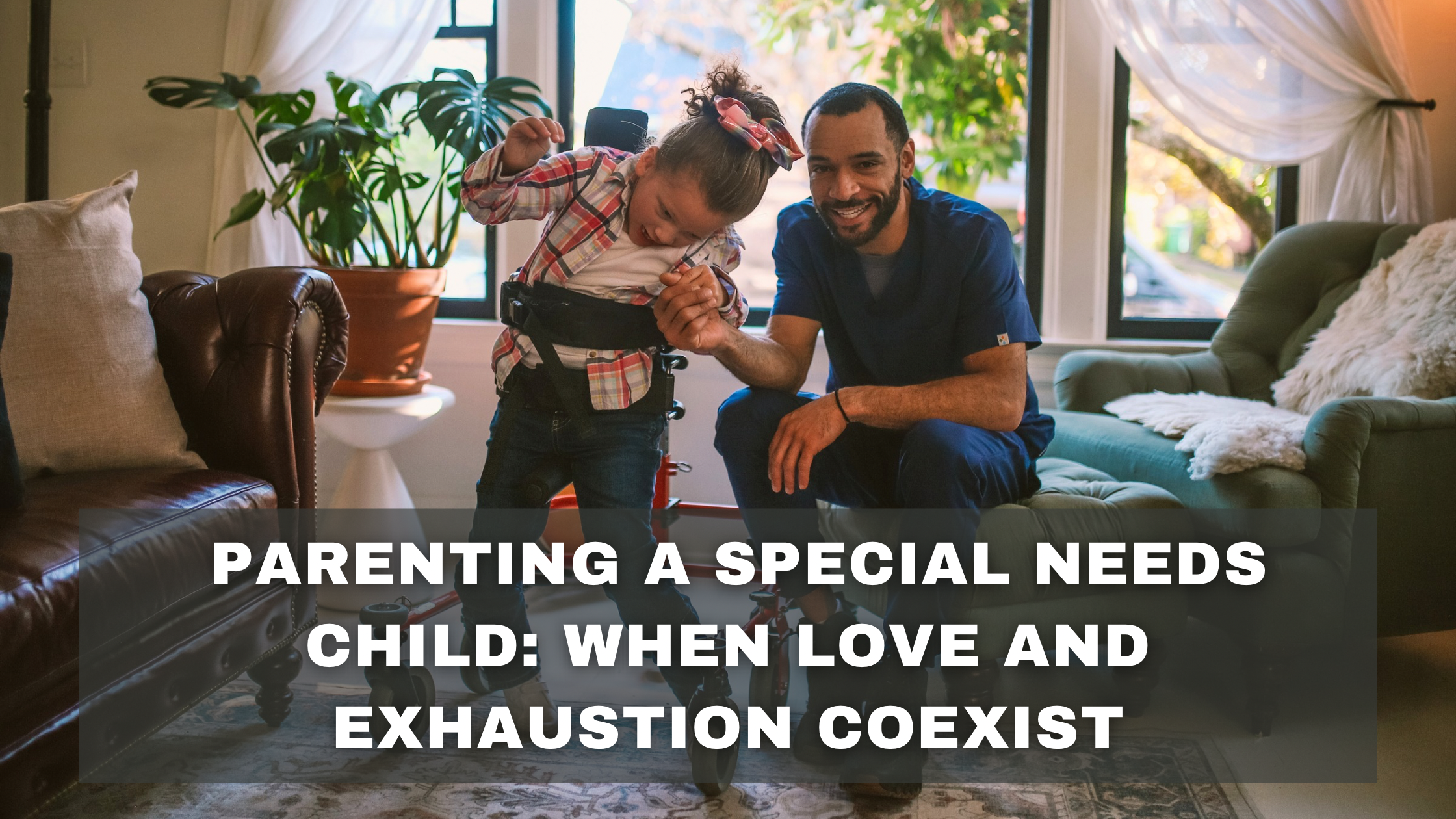
Parenting a Special Needs Child: When Love and Exhaustion Coexist
Parenting a child with special needs often involves a paradox that few discuss openly: deep attachment and chronic strain existing simultaneously.
The love is not in question.
The commitment is not in question.
The exhaustion, however, is real.
For many parents in Davidson, Cornelius, Huntersville, and the greater Lake Norman / Charlotte community, raising a child with developmental, medical, behavioral, or neurodivergent needs requires sustained psychological and logistical effort that extends well beyond typical parenting demands.
This is not a deficit narrative. It is an acknowledgment of complexity.
Understanding the Scope of “Special Needs”
The term “special needs” encompasses a broad spectrum of developmental and medical presentations, including but not limited to:
Autism spectrum disorder (ASD)
Attention-deficit/hyperactivity disorder (ADHD)
Learning disabilities
Sensory processing differences
Intellectual disabilities
Speech and language disorders
Chronic medical conditions
Genetic syndromes
Emotional or behavioral disorders
Physical disabilities
Each diagnosis carries unique strengths, challenges, and trajectories. Importantly, no two families experience these realities in identical ways.
However, across categories, parents often share a common psychological experience: prolonged responsibility under conditions of uncertainty.
The Psychological Load of Sustained Caregiving
Parenting a child with additional needs frequently involves:
Ongoing medical and therapeutic coordination
Educational advocacy (IEPs, 504 plans, evaluations)
Heightened behavioral monitoring
Anticipatory planning for transitions
Financial and scheduling strain
Reduced social spontaneity
This level of responsibility can activate chronic hypervigilance. Parents may feel continually “on,” monitoring subtle cues, anticipating dysregulation, or preparing for the next appointment, transition, or developmental milestone.
Over time, sustained activation of the stress response system can result in:
Emotional fatigue
Decreased tolerance for ambiguity
Irritability or withdrawal
Sleep disruption
Somatic tension
Diminished relational presence
These responses are not evidence of inadequate coping. They are predictable physiological and psychological adaptations to prolonged demand.
Ambiguous Grief and Shifting Expectations
Many parents experience a form of ambiguous grief — not grief for their child, but grief related to evolving expectations.
This may include:
Adjusting anticipated developmental timelines
Recalibrating future independence expectations
Letting go of imagined milestones
Such grief is often cyclical. It can reemerge at transitional stages (school entry, adolescence, adulthood) and may coexist with pride, joy, and admiration for a child’s unique strengths.
Holding both love and loss simultaneously is psychologically complex. It requires space for reflection rather than suppression.
The Impact on Marital and Family Systems
Family systems inevitably reorganize around a child’s additional needs.
Common relational stressors include:
Discrepancies in coping styles between partners
Imbalanced caregiving roles
Reduced couple time
Emotional misattunement under stress
Sibling role shifts
Without intentional communication and support, chronic stress can erode relational resilience.
Therapeutic intervention from a family systems perspective can help clarify roles, reduce reactivity, and strengthen collaborative parenting approaches.
Identity and the Risk of Caregiver Burnout
Parents of children with special needs often report identity constriction.
Caregiving may become the dominant organizing role, leaving little space for:
Personal interests
Professional growth
Social connection
Emotional processing
Caregiver burnout can manifest as:
Emotional numbing
Cynicism
Withdrawal
Reduced empathy
Physical depletion
Importantly, burnout does not reflect diminished love. It reflects prolonged output without adequate restoration.
Sustainable caregiving requires sustainable support.
Evidence-Based Therapy for Parents of Special Needs Children
At Davidson Family Therapy, our work with parents in Davidson, Cornelius, and the Lake Norman / Charlotte region is grounded in:
Evidence-based clinical practice
Trauma-informed frameworks
Neurodiversity-affirming principles
Family systems theory
Stress regulation and nervous system stabilization
Therapy may focus on:
Reducing chronic stress activation
Processing ambiguous grief
Enhancing marital communication
Rebuilding identity beyond caregiving
Developing sustainable coping structures
Strengthening emotional resilience
This is not about pathologizing parenting stress. It is about acknowledging that high-demand caregiving requires structured psychological support.
Inclusive of Diverse Diagnoses and Presentations
Whether your child has a formal diagnosis or is navigating ongoing evaluation, your experience as a parent is valid.
There is no threshold of severity required to seek support.
Parents of children with:
Autism
ADHD
Learning differences
Physical disabilities
Complex medical needs
Emotional or behavioral challenges
all encounter unique layers of responsibility and adaptation.
Support should be proportionate to demand — not delayed until crisis.
Love and Exhaustion Can Coexist
It is possible to be deeply devoted and deeply tired.
It is possible to advocate fiercely and still need rest.
It is possible to feel gratitude and grief at the same time.
Parenting a special needs child is not simply a logistical adjustment. It is an ongoing psychological process.
If you are navigating this complexity in Davidson, Cornelius, Huntersville, or the greater Lake Norman area, therapy can provide a structured, confidential space to strengthen resilience and restore internal steadiness.
This article was written by the Davidson Family Therapy team, based in Cornelius and Davidson, NC, with professional experience providing counseling for parents in the Davidson, Cornelius, Charlotte, and greater Lake Norman community.
📍 Davidson Location:
709 Northeast Drive, Suite 22
Davidson, NC 28036
📍 Cornelius Location:
20501 N Main Street
Cornelius, NC 28031
📞 Phone: 704-912-4095
👉 Tele-Mental Health / Online Therapy Available Anywhere in North Carolina
