
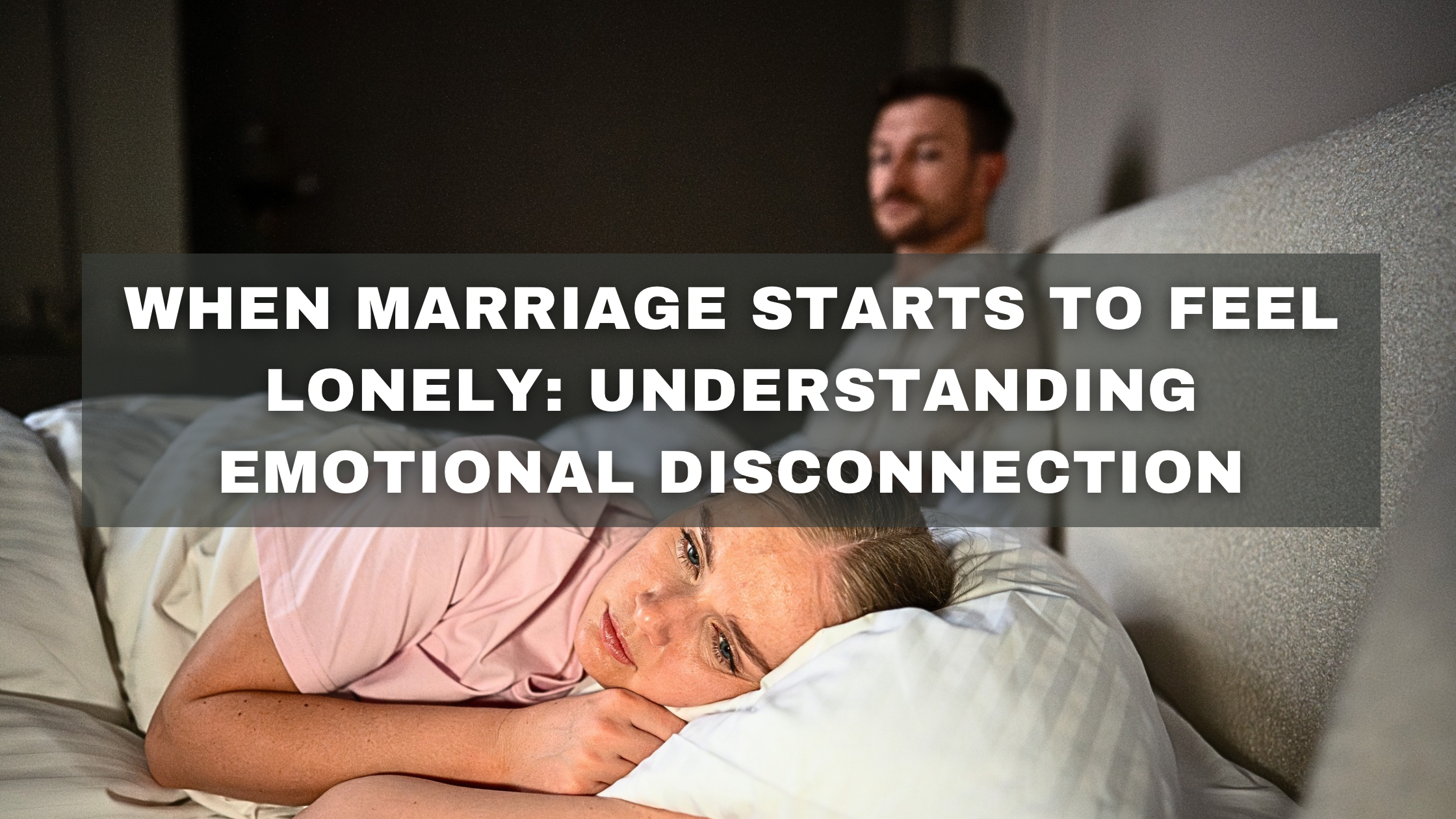
When You’re Together… But Still Feel Alone
One of the most painful experiences in a marriage isn’t conflict—it’s distance.
Many couples don’t initially search for “marriage counseling.” Instead, they quietly type things like:
“Why does my spouse feel distant?”
“Why do we feel like roommates?”
“Why do we keep having the same argument?”
These searches point to something deeper: emotional disconnection in marriage.
From the outside, everything may appear stable. You may still share responsibilities, raise children, and maintain routines. But internally, something feels off—like the relationship has lost its warmth, safety, or closeness.
If this sounds familiar, you’re not alone. Emotional disconnection is one of the most common—and treatable—issues couples face.
What Is Emotional Disconnection in Marriage?

Emotional disconnection occurs when partners no longer feel emotionally attuned, supported, or understood by one another.
It’s not always loud or obvious. In fact, it often shows up quietly:
Conversations feel surface-level or transactional
Affection becomes infrequent or forced
One or both partners feel unseen or unimportant
You stop sharing your inner thoughts or feelings
Time together feels more like obligation than connection
Over time, couples often describe this experience as:
“We’re more like roommates than partners.”
This shift doesn’t mean the relationship is broken—it means something important is missing.
Why Emotional Disconnection Happens
Emotional disconnection rarely happens overnight. It’s usually the result of small patterns that build over time.
1. Communication Breakdowns
Many couples struggle with relationship communication problems—not because they don’t talk, but because they don’t feel heard.
Common patterns include:
Talking at each other instead of with each other
Defensiveness during conflict
Avoiding difficult conversations altogether
Repeating the same arguments without resolution
Over time, partners may stop trying to communicate altogether, leading to emotional withdrawal.
2. Chronic Stress and Life Demands
Careers, parenting, finances, and daily responsibilities can quietly erode connection.
When couples operate in “survival mode,” emotional intimacy often becomes secondary.
Conversations become task-oriented
Quality time decreases
Emotional needs go unaddressed
The relationship shifts from a source of support to just another responsibility.
3. Unresolved Conflict
Every couple has conflict—but when issues remain unresolved, they create emotional distance.
Unresolved conflict can lead to:
Resentment
Emotional shutdown
Avoidance
Passive-aggressive behavior
Eventually, it may feel safer not to engage at all.
4. Emotional Avoidance
Some individuals struggle to express vulnerability due to past experiences, upbringing, or fear of rejection.
This can look like:
Difficulty expressing feelings
Minimizing emotional needs
Changing the subject during deeper conversations
When one or both partners avoid emotional depth, connection begins to fade.
5. Feeling Taken for Granted
Over time, appreciation can quietly disappear.
When partners stop acknowledging each other:
Efforts go unnoticed
Emotional needs feel unimportant
Disconnection grows
Even strong relationships can weaken when appreciation is replaced with assumption.
Signs Your Marriage May Be Emotionally Disconnected

If you’re unsure whether emotional disconnection is present, consider these common indicators:
You feel lonely even when you’re together
Conversations feel repetitive or meaningless
Physical intimacy has decreased significantly
You avoid sharing personal thoughts or feelings
Conflict either escalates quickly—or is avoided entirely
You feel more like co-managers of life than partners
These signs don’t mean your relationship is failing—they signal that connection needs attention.
The Emotional Impact of Disconnection
Emotional disconnection doesn’t just affect the relationship—it affects each partner individually.
Many individuals report:
Increased anxiety or overthinking
Feelings of rejection or inadequacy
Emotional exhaustion
Loss of identity within the relationship
Over time, this can lead to deeper issues such as depression, resentment, or even thoughts of separation.
What makes this especially difficult is that many couples don’t recognize what’s happening—they just know something feels off.
Why Couples Often Wait Too Long to Seek Help
One of the biggest challenges with emotional disconnection is that it feels subtle—until it doesn’t.
Couples often delay seeking marriage counseling because:
“It’s not bad enough yet”
“We’re just going through a phase”
“We don’t have time right now”
Unfortunately, disconnection tends to deepen over time if left unaddressed.
By the time couples reach out, they may already feel significantly distant or discouraged.
How Couples Therapy Helps Rebuild Connection
The good news is that emotional disconnection is highly treatable.
Couples therapy provides a structured, supportive environment where partners can begin to reconnect safely and effectively.
1. Improving Communication
Therapy helps couples move from reactive communication to intentional, effective dialogue.
You’ll learn how to:
Express needs clearly
Listen without defensiveness
Understand each other’s perspectives
2. Identifying Underlying Patterns
Many couples repeat the same arguments because they’re stuck in unconscious patterns.
Therapy helps uncover:
Triggers
Emotional responses
Behavioral cycles
Once these patterns are understood, they can be changed.
3. Rebuilding Emotional Safety
Emotional connection requires safety.
In therapy, couples work to:
Reduce criticism and defensiveness
Increase empathy and understanding
Create a space where vulnerability feels possible
4. Restoring Emotional and Physical Intimacy
As communication and safety improve, intimacy often follows.
Couples begin to:
Feel more connected
Re-engage emotionally
Experience renewed closeness
5. Strengthening the Relationship Foundation
Rather than just “fixing problems,” therapy helps couples build a stronger, more resilient relationship.
This includes:
Shared goals
Improved conflict resolution
Deeper emotional understanding
What Reconnection Actually Looks Like
Reconnection isn’t about becoming a “perfect couple.”
It’s about:
Feeling heard and understood
Being able to share openly
Experiencing warmth and closeness again
Navigating challenges as a team
For many couples, even small shifts can lead to meaningful change.
When to Consider Marriage Counseling
You don’t have to wait for a crisis to seek help.
You may benefit from couples therapy if:
You feel emotionally distant from your partner
Communication feels strained or ineffective
You’re having the same unresolved arguments
You feel more like roommates than partners
You want to strengthen your relationship before things worsen
Early intervention often leads to better outcomes—and less emotional strain.
Disconnection Is Not the End
If your marriage feels lonely right now, it doesn’t mean it’s over.
Emotional disconnection is not a failure—it’s a signal.
It’s your relationship asking for attention, care, and support.
With the right tools and guidance, many couples not only reconnect—but build stronger, more fulfilling relationships than they had before.
If you’ve been feeling distant in your marriage, you don’t have to navigate it alone.
At Davidson Family Therapy, we help couples understand what’s happening beneath the surface and guide them toward meaningful, lasting connection.
Reach out today to schedule a consultation and take the first step toward reconnecting.
This article was written by the Davidson Family Therapy team, based in Cornelius and Davidson, NC, with professional experience providing couples counseling in the Davidson, Cornelius, Charlotte, and greater Lake Norman community.
📍 Davidson Location:
709 Northeast Drive, Suite 22
Davidson, NC 28036
📍 Cornelius Location:
20501 N Main Street
Cornelius, NC 28031
📞 Phone: 704-912-4095
👉 Tele-Mental Health / Online Therapy Available Anywhere in North Carolina
